
Electrical Division
Find products
Electrical Drive Systems Engineering
LV Variables Speed Drives / VFD Standalone Panel
LV Motors & Gearbox
Soft Starters
Medium/High Voltage Drives, Motors
Medium/High Voltage Motors & Generators
HV & MV Switchgear (GIS/AIS)
Special Cables
Cables
Enclosed Switch - Disconnectors
Lightning Protection System - Furse ABB
Earthing System - Furse ABB
Cable Management System
Cable Support System
Conduit System
Industrial Plugs And Sockets
Polycarbonate Junction Boxes
Explosion Proof Products
Uninterruptible Power Supply
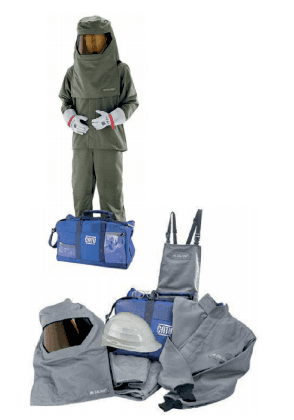
An electric arc follows a short circuit. It produces nearly instant effects with serious consequences without proper protection.
When electric arc danger exists, heat-resistant clothing must be worn. The arc’s characteristics are given by: The resistance value of the free arc, expressed in cal/cm2 according to NFPA 70 E, ASTM standards, and IEC 61482-1-1. or The protection class (1 or 2) with a constrained arc according to IEC 61482-1-2.
PROTECTION AGAINST ARC FLASH
The following are used to determine the proper equipment for protecting against an electric arc.
The maximum fault current value.
The phase/ground rated voltage at the site of the risk.
The distance between the source of the arc and the reception surface.
The AC cycle number and the mono or three-phase circuit type.
The location where the arc is produced (confined space).
After recording these parameters, we can estimate the level of risk and determine
The proper protective clothing and PPE to use: 8 to 100 cal/cm2 or class 1 or 2.